Asteroid Near Earth? How to Read the Orbit Without Jumping to Conclusions
A near-Earth asteroid is not automatically headed for Earth. The useful distinction is between orbital category, close-approach geometry, and uncertainty-aware impact monitoring.
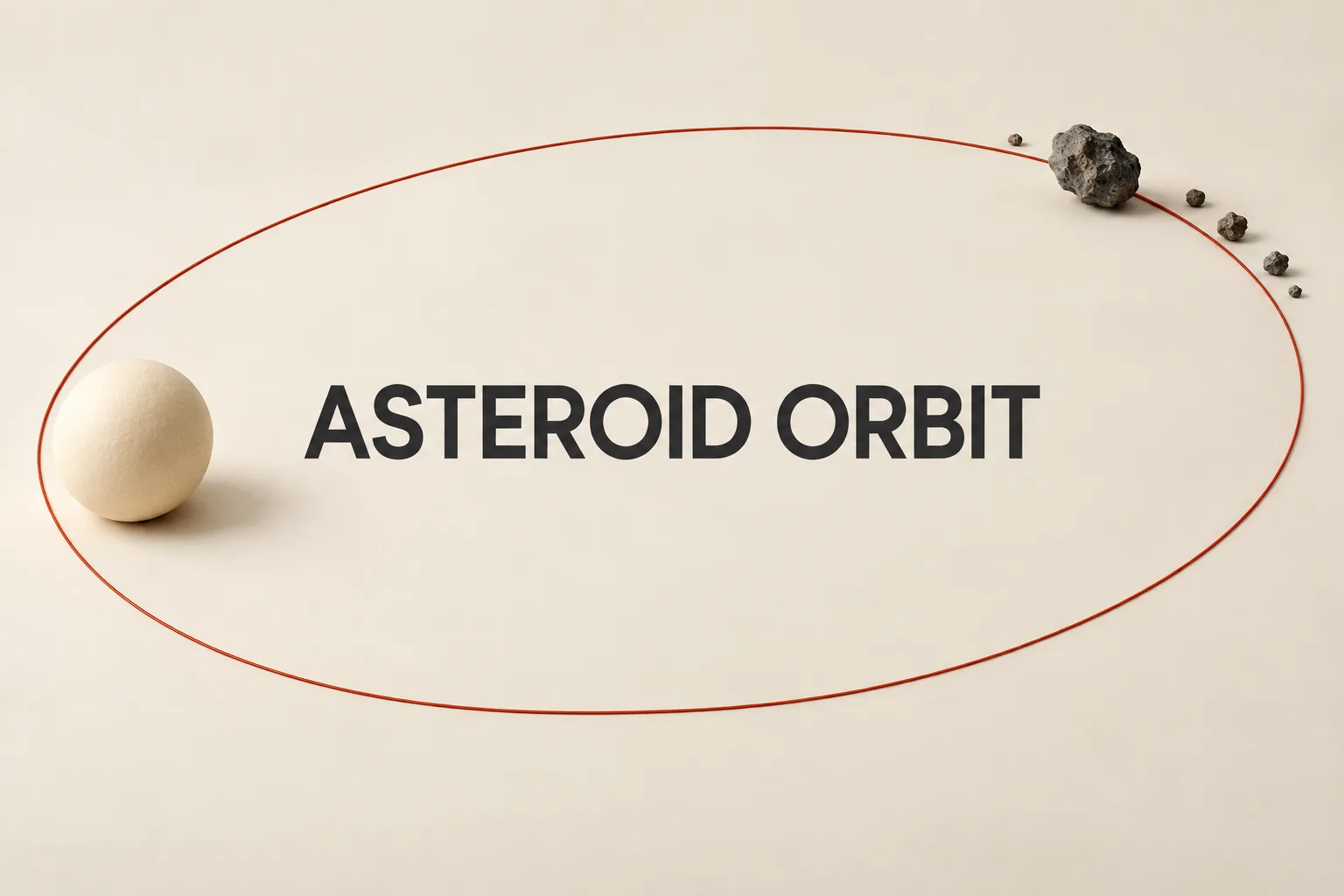
An asteroid can be in Earth’s orbital neighborhood without being on a collision course. The useful question is not simply whether it is “near,” but what the orbital label means, how the close approach is calculated, and how much uncertainty remains.
“Near-Earth” describes an orbit, not an impact forecast
NASA defines a near-Earth object (NEO) as an asteroid or comet whose orbit comes within about 30 million miles (48 million kilometers) of Earth’s orbit. That is a statement about orbital geometry, not a prediction that the object will hit Earth. Most asteroids remain in the main asteroid belt between Mars and Jupiter, while some have orbits that enter Earth’s orbital neighborhood. NASA’s Asteroid Facts provides that broader classification.
This distinction matters because “near-Earth” sounds like a distance measured from a person standing on Earth. It is not. The label identifies the relationship between two paths around the Sun. A headline using the term therefore provides a reason to inspect the orbit, not a conclusion about danger.
“Potentially hazardous” is a screening label
NASA’s Center for Near Earth Object Studies (CNEOS) applies the potentially hazardous asteroid (PHA) label when a near-Earth asteroid meets both of these conditions:
- Its Earth Minimum Orbit Intersection Distance is 0.05 astronomical units or less—about 4.6 million miles (7.5 million kilometers).
- Its absolute magnitude is 22.0 or brighter, which roughly corresponds to an estimated diameter of at least 140 meters (460 feet), depending on reflectivity.
The two conditions work together: one concerns how closely the asteroid’s orbit could approach Earth’s orbit, and the other is a size-related brightness threshold. As CNEOS explains in NEO Basics, “potentially hazardous” does not mean an impact is currently predicted. It identifies an object whose orbital geometry and estimated size warrant continued attention.
That also means the PHA label is not a complete safety verdict in either direction. It answers one screening question. It does not replace an impact-probability calculation for a particular object and future date.
A close-approach table contains more than one distance
For a specific encounter, CNEOS separates the most likely result from the uncertainty around the orbit. Its close-approach information defines the nominal distance as the predicted distance between the centers of Earth and the asteroid based on the best-fit orbit. The minimum distance is derived from the modeled 3-sigma target-plane uncertainty region.
Those values should not be read as two equally likely passes. The minimum is not a second expected trajectory; it describes how close the edge of the modeled uncertainty region could come. The table’s distances are also measured from Earth’s center, not from the ground at a particular location.
CNEOS also presents the predicted approach date, relative velocity, absolute magnitude, and diameter information. Keeping those fields together is more useful than repeating a single distance: the date identifies the encounter being discussed, the distance describes the nominal geometry, and the uncertainty indicates how firmly that geometry is known.
Why an impact probability can change without the asteroid changing course
CNEOS’s Sentry system continually updates its orbit and close-approach calculations when new observations become available. The Sentry FAQ explains that additional observations can narrow the range of possible orbits. A possible impact may then disappear from the risk list, or the calculated probability may change while the system tests the smaller remaining range of possibilities.
That is why a probability increase does not, by itself, show that an asteroid suddenly became more dangerous or changed direction. It can mean that the observations have reduced the uncertainty while an impact-compatible orbit is still among the possibilities. Sentry searches for possible impacts during the next 100 years, using the observations available at the time of each calculation.
The useful way to interpret an asteroid alert
The definitions, close-approach table, and Sentry results answer different questions. The definitions say what kind of object is being discussed. The close-approach data describe the predicted encounter and its uncertainty. Sentry addresses whether the currently allowed orbits include a possible Earth impact and how that assessment changes with new observations.
The important mental shift is simple: proximity is geometry, “potentially hazardous” is a size-and-orbit screen, and impact probability is an uncertainty calculation. Keeping those ideas separate turns “asteroid near Earth” from an alarming conclusion into a question that can be checked against the object’s orbit and the evidence supporting it.