Why Does a Satellite’s Orbit Matter?
“Satellite” describes an object in orbit, not a single kind of service. Its orbit helps explain what it can observe, how it moves relative to Earth, and why different missions use different paths.
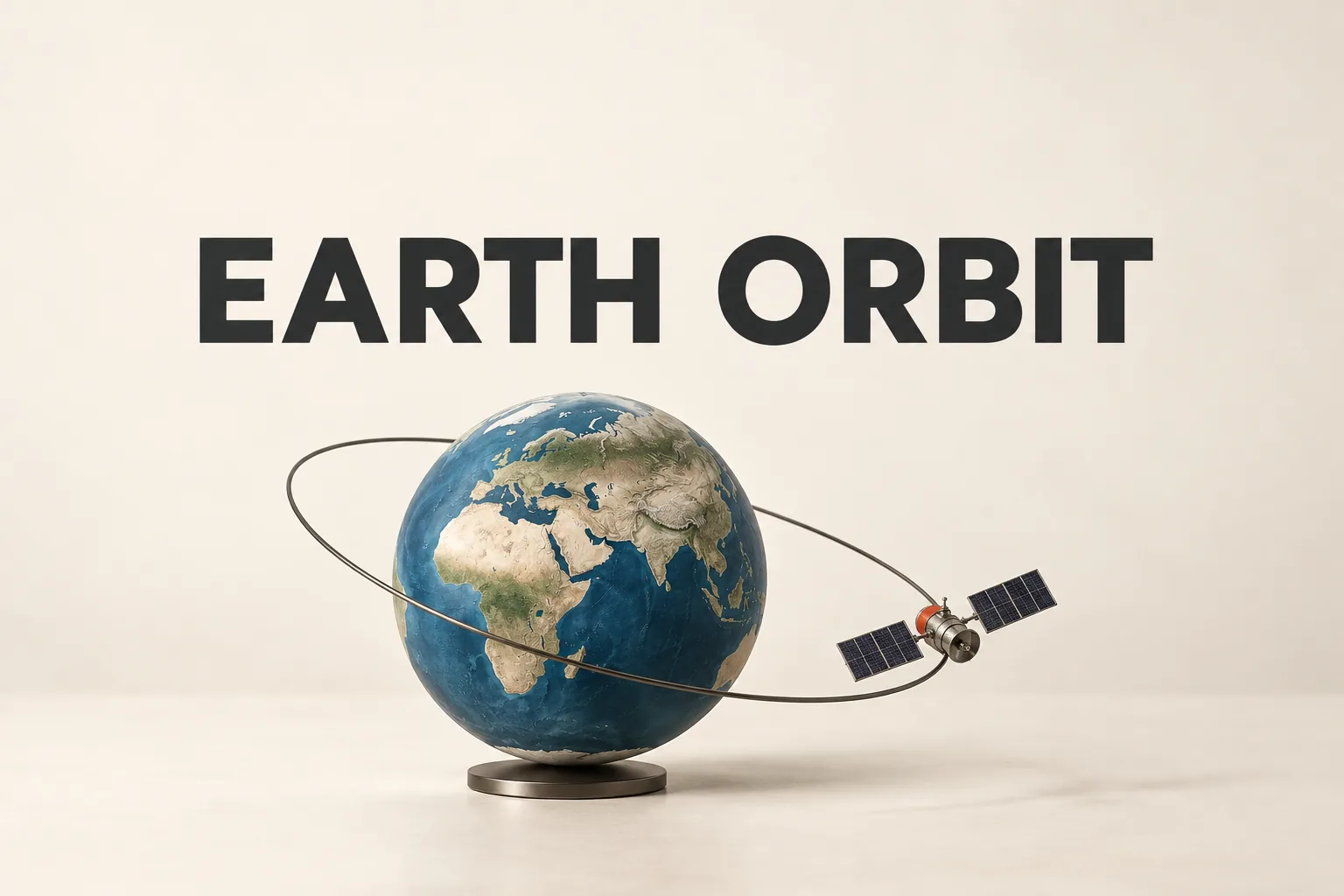
A satellite is a platform, not a single kind of service
NASA defines a satellite as an object that orbits another object in space. Some are natural, such as the Moon; artificial satellites are human-made spacecraft equipped for specific missions. NASA lists uses including observing Earth, studying the Sun, exploring other worlds, and investigating the universe.
That distinction changes how to read the word “satellite.” It tells you that something is orbiting, but not what it is designed to do. The more useful question is: what relationship with Earth does its orbit make possible?
What changes when the orbit changes?
NASA’s catalog of Earth satellite orbits describes three broad altitude categories, along with differences in orbital shape and inclination:
- Low Earth orbit (LEO): Many scientific and Earth-observing satellites operate here. NASA also describes polar and Sun-synchronous orbits in this category and gives an Earth-observing example at about 705 kilometers altitude with an orbital period of approximately 99 minutes.
- Medium Earth orbit (MEO): GPS satellites use a semi-synchronous orbit at about 20,200 kilometers above Earth and complete an orbit in roughly 12 hours.
- High Earth orbit: Geosynchronous orbits are about 36,000 kilometers above Earth. A geostationary satellite is above the equator and appears to remain over one location as Earth rotates.
These are not interchangeable labels. A satellite that moves around Earth quickly and repeatedly passes over different areas provides a different viewing pattern from one that appears fixed over a region. The orbit is therefore part of the mission design, not just a technical detail.
Why weather monitoring favors a fixed view
NOAA’s geostationary satellite explanation gives a concrete example. Its GOES satellites orbit approximately 22,236 miles above the equator, and their orbital speed matches Earth’s rotation. As a result, they can continuously observe nearly the same geographic area.
That arrangement is useful for watching weather systems develop over a region. It also explains why a weather-observation satellite and another Earth-observing satellite may produce very different kinds of information even though both are simply called satellites: one is positioned for persistent regional coverage, while another may be designed to collect observations as it moves across the planet.
The important point is not that one orbit is universally superior. It is that each orbit creates a different connection between the spacecraft and the ground below it.
A better way to evaluate satellite claims
When a description says that a satellite supports weather, navigation, communications, or research, separate the claim into three questions:
- What is the mission? NASA says artificial satellites carry equipment for particular purposes, so the payload matters as much as the spacecraft’s name.
- What orbit does it use? LEO, MEO, and geostationary orbit imply different movement and coverage patterns.
- What must remain observable? NOAA’s GOES example shows the value of keeping nearly the same region in view. A different mission may need repeated passes, global coverage, or a navigation constellation instead.
This framework prevents a common mistake: treating “satellite” as if it automatically means a specific capability. The word describes the platform’s location in space. The mission and orbit together explain what that platform can contribute.
The takeaway
A satellite’s orbit matters because it determines how the spacecraft moves relative to Earth. LEO, MEO, and geostationary orbits support different observation and service patterns. NOAA’s GOES system makes the idea easy to see: matching Earth’s rotation enables continuous observation of nearly the same region.
So the next time a satellite is mentioned, start with two questions: What is it carrying, and how is it orbiting? Those answers reveal far more than the word “satellite” alone.