Humpback Whales Aren’t Performing: How to Read a Breach, Song, or Bubble Net
A bubble net, a song, and a breach are not interchangeable signs. Context determines what each behavior can reasonably tell us.
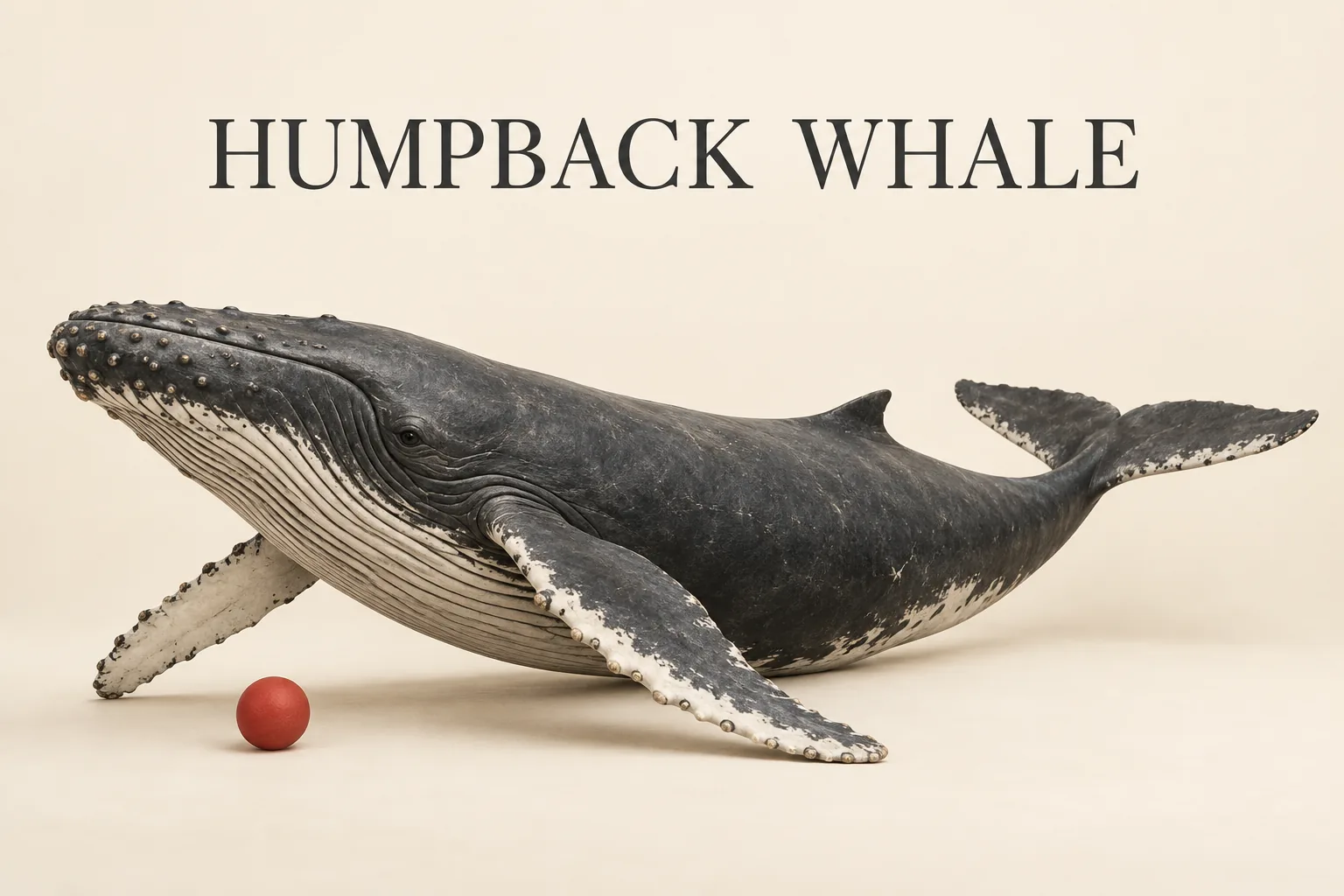
Humpback Whales Aren’t Performing: How to Read a Breach, Song, or Bubble Net
A humpback whale is easy to remember as a spectacle: a body above the surface, a tail on the water, or a ring of bubbles. But the behavior makes more sense when read as a response to a particular problem—finding concentrated food, communicating during breeding, or moving between habitats. NOAA’s species profile supports that broader frame while also leaving some motives unresolved.
The useful habit is to separate what can be observed from what can be inferred.
Why a bubble net is more than a dramatic circle
Humpbacks are baleen whales. NOAA says their diet centers on krill and small fish, and that they may use bubbles, sounds, the seafloor, and their pectoral fins to herd or disorient prey. In bubble-net feeding, humpbacks create a curtain or ring of bubbles that concentrates prey before the whales lunge upward through it with their mouths open. (NOAA Fisheries species profile)
The sequence matters. The bubbles are not just a visible signature; they alter where the prey is, making the final lunge possible. That is a synthesis from the behavior NOAA describes—not a claim that every humpback uses the same tactic. NOAA notes that feeding strategies vary by region.
It also turns a viewing tip into a meaningful rule. NOAA Fisheries says never approach or drive through bubbles because a feeding humpback may surface within or near the cloud. Apparent empty water can be the center of the feeding behavior, not a safe gap. (NOAA vessel guidance)
What a song tells us—and what it does not
Songs need a different interpretation. NOAA Ocean Service describes whale sounds as communication and says male humpbacks sing during the breeding season. Possible explanations include attracting mates or establishing territory, but the exact function is not fully settled. (NOAA Ocean Service)
The practical distinction is between context and certainty: a song can point toward a breeding-related social setting, but it does not let an observer prove one specific motive. Calling every song a mating call adds certainty that the official evidence does not provide.
Why location and season change the reading
Place and season are not background details. NOAA Fisheries describes seasonal movement between high-latitude feeding grounds and tropical or subtropical breeding and calving grounds. During the feeding season, humpbacks build blubber reserves that support migration and the winter breeding period. (NOAA Fisheries species profile)
That means the same surface event can sit in a different biological context depending on whether the whale is near a feeding area or a breeding and calving area. Context cannot identify an individual whale’s intent, but it prevents the common mistake of treating a famous behavior as if it has one meaning everywhere.
What a breach can—and cannot—tell you
The NOAA profile lists breaching, tail slaps, pectoral-fin slaps, and lunges among humpback surface behaviors, but it does not present breaching as a single-purpose signal. A precise description is simply that a humpback breached. Any explanation of why needs additional context rather than an automatic story about mood or motive. (NOAA Fisheries species profile)
That restraint is useful beyond whale watching. It keeps an impressive observation separate from an unsupported interpretation—the same distinction needed when reading wildlife videos, captions, or headlines.
Why the conservation label depends on the population
Conservation language requires the same discipline. NOAA’s Endangered Species Act listing page separates humpbacks into 14 distinct population segments: four endangered, one threatened, and nine not listed under the ESA. NOAA also says all humpback whales are protected under the Marine Mammal Protection Act. (NOAA Fisheries ESA listing)
Those statements answer different questions. An ESA label is population-specific, while Marine Mammal Protection Act protection applies across the species. So not listed under the ESA should not be casually rewritten as unprotected.
A bubble net is evidence of a feeding strategy; seasonal range helps frame whether feeding or breeding is likely; a male song is breeding-linked communication with an unresolved exact purpose; and a breach is a striking observation, not a complete explanation. Read the behavior in context, keep uncertainty visible, and give bubble clouds the distance NOAA’s safety guidance requires.