AMD Radeon: How to Choose Between RX 9070 XT, RX 9070, and RX 9060 XT
AMD Radeon becomes easier to evaluate when resolution, memory capacity, power, and software support are considered in that order.
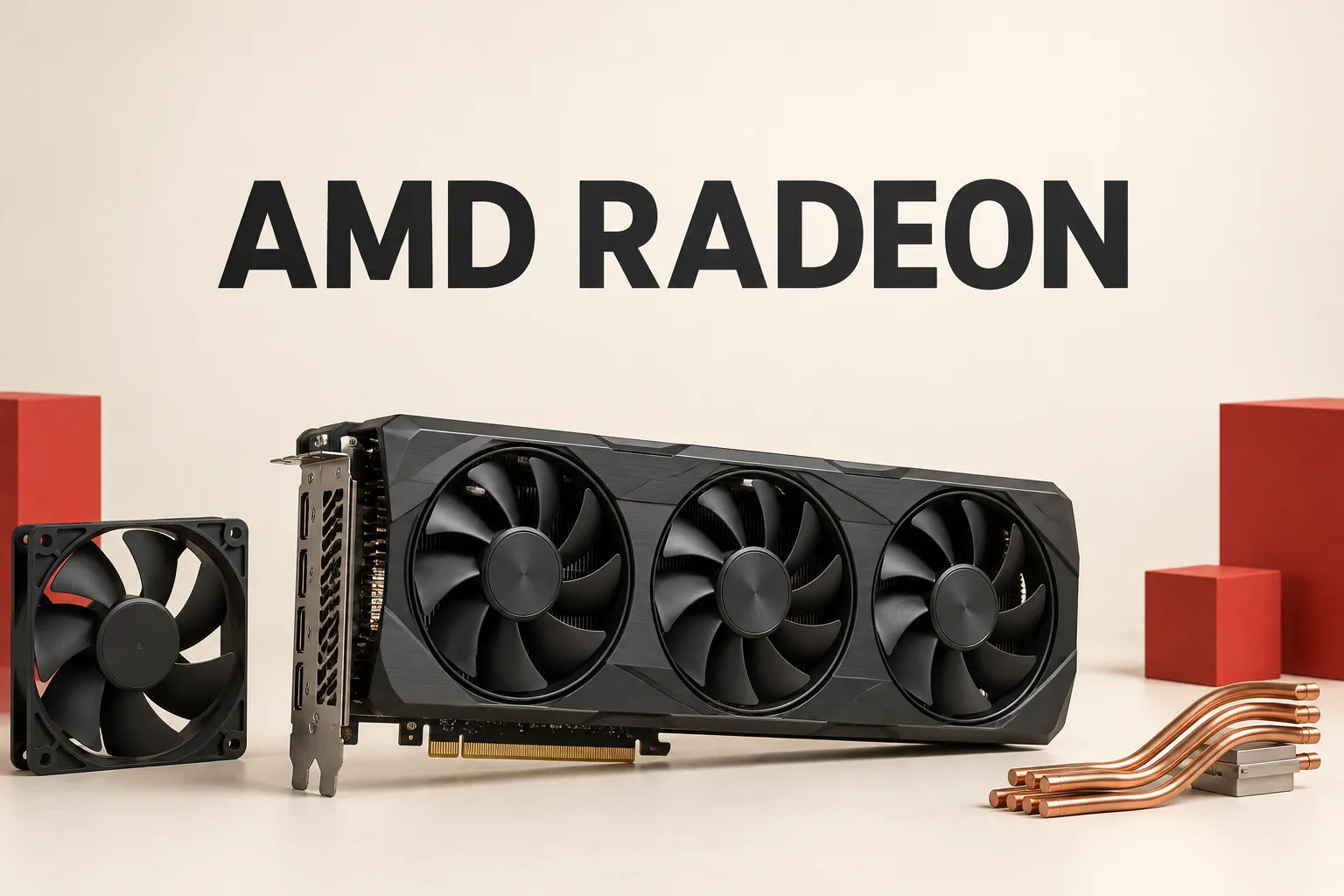
AMD Radeon gets easier to evaluate when the question is narrowed. The useful question is not which card wins a generic ranking. It is which current RX 9000 card matches the display target, memory capacity, and power boundary—and whether the game uses the software features attached to the Radeon name.
Start with the workload AMD actually puts on each page
AMD frames the Radeon RX 9070 XT with 4K Ultra examples, while the Radeon RX 9060 XT page uses 1440p Ultra examples. These are AMD’s own test framing, not a universal performance guarantee. Still, the distinction is useful: use the resolution you actually target to narrow the field, then treat the game and its settings as the final variable.
The hardware boundaries on AMD’s product pages are equally important:
| Card | VRAM | Typical board power | AMD-listed PSU recommendation | Power connector |
|---|---|---|---|---|
| RX 9070 XT | 16GB GDDR6 | 304W | 750W | 2 × 8-pin |
| RX 9070 | 16GB GDDR6 | 220W | 650W | 2 × 8-pin |
| RX 9060 XT 16GB | 16GB GDDR6 | 160W | 450W | 1 × 8-pin |
| RX 9060 XT 8GB | 8GB GDDR6 | 150W | 450W | 1 × 8-pin |
This changes how the model numbers should be read. The RX 9070 XT’s higher board power and PSU recommendation are not details to check after choosing the card; they are part of whether it belongs on the shortlist at all. The RX 9070 offers the same listed 16GB capacity as the XT, but AMD gives it a different 220W and 650W power envelope. That is a system-fit distinction, not proof of a particular game-performance tier.
The RX 9060 XT choice is mainly a memory-capacity question
AMD lists the 8GB and 16GB RX 9060 XT versions with the same 32 compute units and the same listed game and boost frequencies. The published differences include memory capacity and typical board power: 16GB and 160W versus 8GB and 150W.
That supports a precise conclusion: the 16GB model is not presented as a different compute configuration on the specification page. The decision is primarily about how much video memory the workload can use. It does not, by itself, establish a fixed frame-rate advantage in every game.
This is why VRAM should be treated as a constraint rather than a performance score. If the shortlist is already the RX 9060 XT family, compare the memory capacity with the games and settings being considered instead of assuming that the larger number automatically answers every performance question.
Radeon features are conditional on the game
The hardware decision is only one layer. AMD’s HYPR-RX page describes a profile that can combine Radeon Anti-Lag, AMD Fluid Motion Frames 2.1, Radeon Super Resolution, Radeon Boost, and FidelityFX Super Resolution. AMD also states that HYPR-RX does not enable every feature in every game, and that HYPR-Tune can apply different combinations of driver and in-game settings.
That makes feature support conditional, not a single guaranteed result. A Radeon card can have access to a feature while a particular game uses a different path—or does not use that feature at all. The practical question is therefore not simply whether a card lists HYPR-RX, but which feature the game supports and how that feature is configured.
The naming is also changing. AMD’s current FSR Technologies page describes FSR Upscaling 4.1 within the broader FSR Redstone suite and lists availability on Radeon RX 7000 and RX 9000 Series graphics cards. AMD notes that some games may still show the older FSR 4 label in their settings menus. That distinction matters when matching a product page to an actual in-game option.
A buying rule that does not overpromise
For a 4K target, the RX 9070 XT is the page AMD frames with 4K Ultra examples, so its 16GB capacity and 750W PSU recommendation should be evaluated together. For a 1440p target, the RX 9060 XT page is the one framed with 1440p Ultra examples; after that, the 8GB-versus-16GB decision becomes the key specification question.
If the shortlist requires 16GB but the RX 9070 XT’s power envelope does not fit the system, the RX 9070 is worth evaluating because AMD lists 16GB at 220W and a 650W PSU recommendation. That is a compatibility inference from the published specifications, not an official performance ranking.
The most defensible order is resolution first, memory capacity second, power and connectors third, and game-feature support last. This prevents a software toggle from distracting from a hardware mismatch—and prevents a VRAM number from being treated as a universal benchmark.